
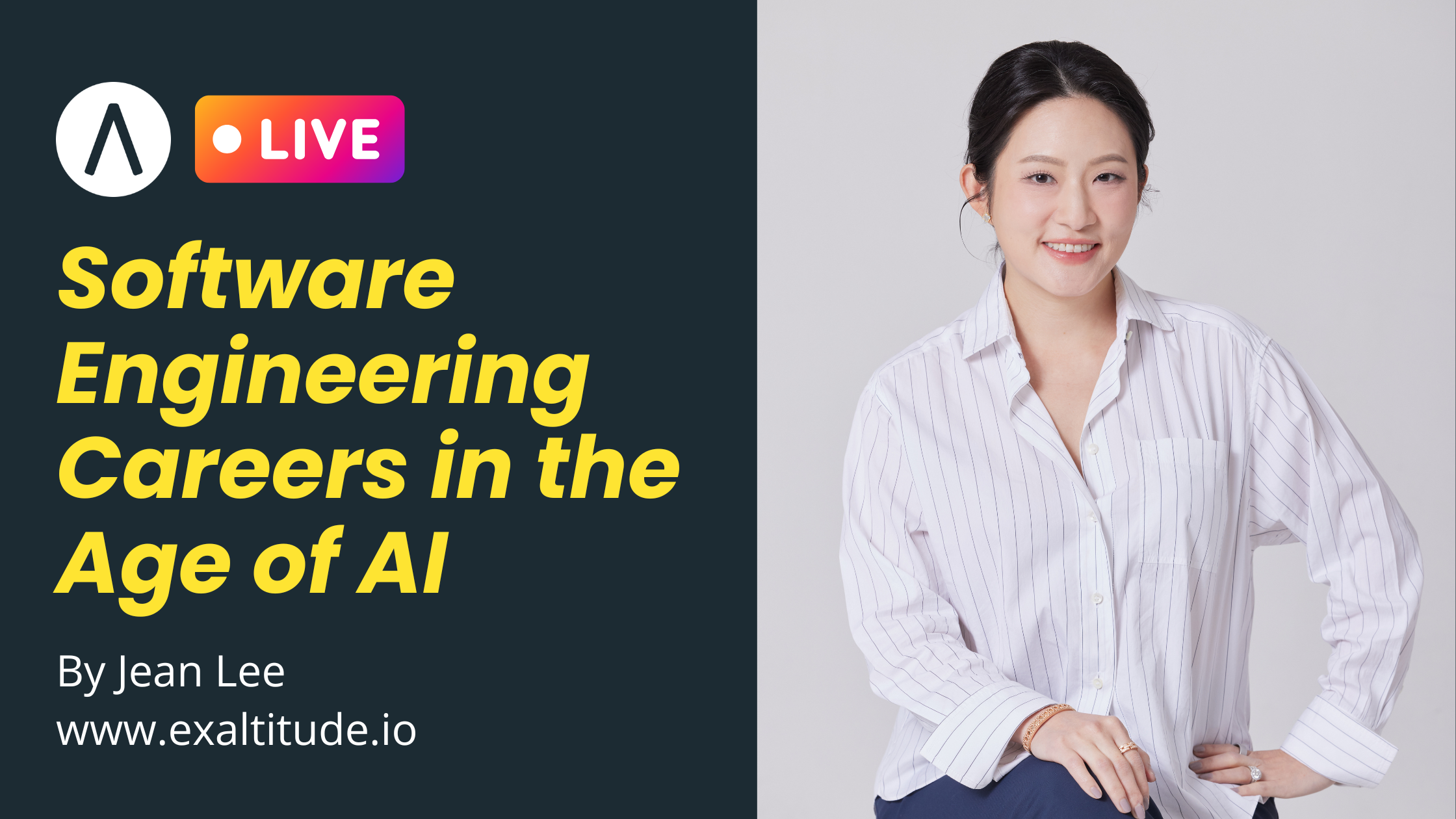
Join me for 30 minutes of advice and lessons learned from my own trial and error. I'll share tips on navigating your career journey, so you don't have to go through the same struggles. This is the talk I wish I had had when I was starting my career.
Exaltitude newsletter is packed with advice for navigating your engineering career journey successfully. Sign up to stay tuned!
Thank you to everyone who showed up to the live Q&A. I was blown away by the thoughtfulness of your questions. We covered AI careers, degrees, switching roles, data science, AI coding tools, and how to future-proof your skills in a fast-changing job market.
Below is a recap of the biggest questions from the session.
If you missed it, or if you want to go deeper, I’m hosting another live event in January.
[LinkedIn] Reserve your spot here.
[YouTube] Sign up for notifications here.
Q: What is the scope of data analytics? Can I switch to data science?
A: Absolutely. This is one of the most common transitions I see. Careers evolve.
A data analyst can shift into data science, then to data engineering, and eventually into AI engineering once they’re in the industry. The hardest part is simply breaking in. After that, roles become fluid.
Q: What do you think about data engineering as a career path?
A: It's a fantastic role. Data engineers often get exposed to pipelines, tooling, and infrastructure that naturally lead toward data science, ML engineering, or AI engineering. If you can land it, try it. Every job you take becomes a stepping stone.
Q: How can I incorporate AI skills into a support/admin role?
A: Start with an inventory of your daily tasks. Identify what takes the most time, scheduling, documentation, note-taking, workflows, and map AI tools to those tasks.
If AI saves you even 10 percent of your time, use that time to develop deeper AI expertise or pitch new AI-driven improvements. Incremental changes compound. That’s how you become indispensable.
Q: Do I need a four-year degree to work in AI?
A: It depends.
Academia, research, and certain big tech roles may still require formal credentials. But many roles don’t, and the fastest way to know is simply to search LinkedIn job postings. See how many actually require a degree vs how many don’t.
If you can demonstrate skill through projects, proof-of-work, or interviews, a degree is not always necessary.
Q: Should I get a master’s degree in AI?
A: Consider why you want it.
If you already have a job, one of the cheapest, most efficient ways to skill up is to incorporate AI into your current workflow. You're getting paid to learn, not paying tuition.
But if you want the university experience, research labs, professors, newest research exposure, then a degree can be meaningful.
It’s not required for most roles, but it can be valuable depending on your goals.
Q: What are the pros and cons of mixing traditional Python coding with vibe coding?
A: Vibe coding is great for prototyping and MVPs, but it breaks down with complex or enterprise systems. The bigger the project, the less reliable it becomes.
There are also more structured AI coding tools that perform better at scale. In my upcoming video, I talk about how to decide which parts of your workflow to automate with AI vs which parts to code manually.
For tips on how to use AI coding effectively, watch "99% of Engineers Are Using AI Tools Wrong."
Q: I’m self-employed. Where do I even begin with AI?
A: Start with a roadmap.
I recommend beginning with my Realistic AI Engineering Roadmap on YouTube. It’s beginner-friendly and based on “chip-human” style AI engineering workflows. Download the accompanying PDF roadmap.
Q: How do I show employers the skills I have?
A: According to a survey of Fortune 500 companies, hiring managers look for three things:
For engineers, “proof of skill” usually means technical interviews, LeetCode, or system design. But your resume determines whether you get the interview at all.
Make sure your resume demonstrates impact, not tasks. Show the skills employers are actively searching for. I walk through this in detail in my Ultimate Resume Handbook.
I’ll be hosting another live session in January, diving deeper into:
• AI careers
• Skill pathways
• How to future-proof your job
• What companies actually look for
• Realistic AI learning plans
[LinkedIn] Reserve your spot here.
[YouTube] Sign up here.
If you want your question included in the next session, leave a comment on the events!
Exaltitude newsletter is packed with advice for navigating your engineering career journey successfully. Sign up to stay tuned!

.png)